CRM Data Entry for Storage Facilities.
Use AI crm data entry to help storage facilities automate customer requests, improve response times, and convert more leads.




CRM records are incomplete because teams avoid manual data entry.
Storage Facilities often lose revenue when customer requests are handled manually, delayed, or never properly tracked.
AI updates records, summarizes conversations, tags contacts, and keeps pipeline data clean automatically.
Storage Facilities can use AI crm data entry to reduce manual work, improve response speed, and create a more predictable process for handling customer requests.
Storage Facilities operate in a market where speed, accuracy, and consistency directly determine revenue. Storage Facilities often lose revenue when customer requests are handled manually, delayed, or never properly tracked. The teams that win are the ones that remove manual handoffs from their crm data entry workflow and reinvest that time into the work humans are actually best at — relationships, judgment, and edge cases.
We build production-grade AI crm data entry systems specifically for storage facilities. Not a generic chatbot bolted onto your website. A custom-engineered workflow that plugs into the tools your sales team already uses, mirrors your existing process, and escalates anything ambiguous to a human with full context. The result: cleaner data and better sales visibility.
- CRM integration
- email and SMS automation
- dashboard reporting
- human handoff
- approval workflows
- audit logs
- HubSpot
- Salesforce
- Google Calendar
- Outlook
- Twilio
- Zapier
- QuickBooks
From audit to live in 4–6 weeks.
1 — Workflow audit
We map your existing crm data entry process end-to-end — every channel, every handoff, every exception your sales team handles today. We benchmark response times, drop-off points, and the volume of edge cases. You walk away with a written audit even if you don't move forward.
2 — Design the agent
We design the AI workflow on paper first — decision tree, prompts, knowledge sources, integrations into HubSpot, Salesforce, Google Calendar, and the exact escalation rules. We pick the model (typically GPT-5.4 or Gemini 2.5 Pro) based on your latency, cost, and accuracy targets for crm data entry.
3 — Build, integrate, train
We build the agent, wire it into your HubSpot and the rest of your stack, and load it with your storage facilities knowledge base, scripts, and historical examples. We test it against months of your real crm data entry transcripts before it ever touches a live customer.
4 — Launch + tune
We run a shadow-mode pilot for one to two weeks where the AI runs alongside your team but doesn't take action. You review every output. Then we flip the switch with clear human-in-the-loop checkpoints and tune weekly based on real outcomes for storage facilities.
What Storage Facilities typically see in the first 60 days.
Every inbound crm data entry request answered in under a minute, 24/7.
Typical lift after 60 days of AI crm data entry for storage facilities.
Less spend on manual coverage, more spent on closing.
Ranges reflect typical results across our sales engagements. Your numbers depend on baseline, volume, and how aggressively you scope automation.
Everything in the build.
- Production AI crm data entry agent custom-built for storage facilities
- Live integrations with HubSpot, Salesforce, Google Calendar, Outlook
- Knowledge base loaded with your storage facilities scripts, pricing, and policies
- Human-in-the-loop dashboard for review, approvals, and overrides
- Conversation logs, audit trail, and sales performance dashboards
- Escalation rules with clear ownership and SLA targets
- Two-week shadow pilot + weekly tuning for the first 60 days
- Handoff docs, runbooks, and training for your sales team
Custom-built. Not configured.
We're a custom AI development team — not a SaaS vendor selling the same product to everyone. We've shipped AI crm data entry systems for storage facilities and adjacent verticals, and we know which patterns hold up in production and which ones break the first time real customers hit them. Every engagement comes with senior engineers, a written audit, a fixed scope, and weekly demos.
Questions storage facilities ask us most.
How is this different from off-the-shelf AI crm data entry tools?+
Off-the-shelf tools are built for the average company across every industry. We build for Storage Facilities specifically. Your agent knows your pricing, your service area, your SKUs, your common objections, and your existing workflow in HubSpot. It hands off to your team the same way a trained employee would.
What integrations are supported?+
Out of the box we integrate with HubSpot, Salesforce, Google Calendar, Outlook, Twilio, Zapier, QuickBooks. We also build custom integrations to internal systems, legacy databases, and proprietary platforms common in storage facilities. If it has an API — or even a half-decent webhook — we can wire it in.
Will it sound robotic to my customers?+
No. We tune the voice and tone to your brand, load it with examples of your best human conversations, and have it identify itself as an AI assistant when asked. For storage facilities, this transparency actually increases trust — customers know they'll get fast answers and a human when it matters.
How does the human handoff work?+
Every AI crm data entry workflow includes explicit escalation rules. The agent knows when a conversation is out of scope, when sentiment turns negative, when a high-value opportunity surfaces, or when a regulatory edge case appears. It routes the full context to the right person on your sales team — they never have to ask the customer to repeat themselves.
How long does it take to launch?+
Most crm data entry agents for storage facilities go live in 4–6 weeks: one week for audit and design, two to three weeks to build and integrate, one to two weeks of shadow-mode piloting, then live with weekly tuning for the first 60 days.
What does it cost?+
Pricing depends on volume, integration complexity, and whether you need voice. Most storage facilities crm data entry engagements start at a fixed build fee plus a per-conversation or per-task runtime cost. We scope and quote in the audit — no surprises later.
Who owns the system and the data?+
You do. Code, prompts, knowledge base, conversation logs, and model fine-tunes are yours from day one. We can host it for you or hand off to your team. No lock-in.
Is it compliant and secure?+
Yes. We build with SOC2-ready architecture, support data residency, redact PII before it hits external model providers when needed, and produce a full audit trail of every AI action — important for storage facilities where regulators or customers may ask.
Real builds we've shipped
We don't just write playbooks — we ship them. A few production launches from the Envert team.
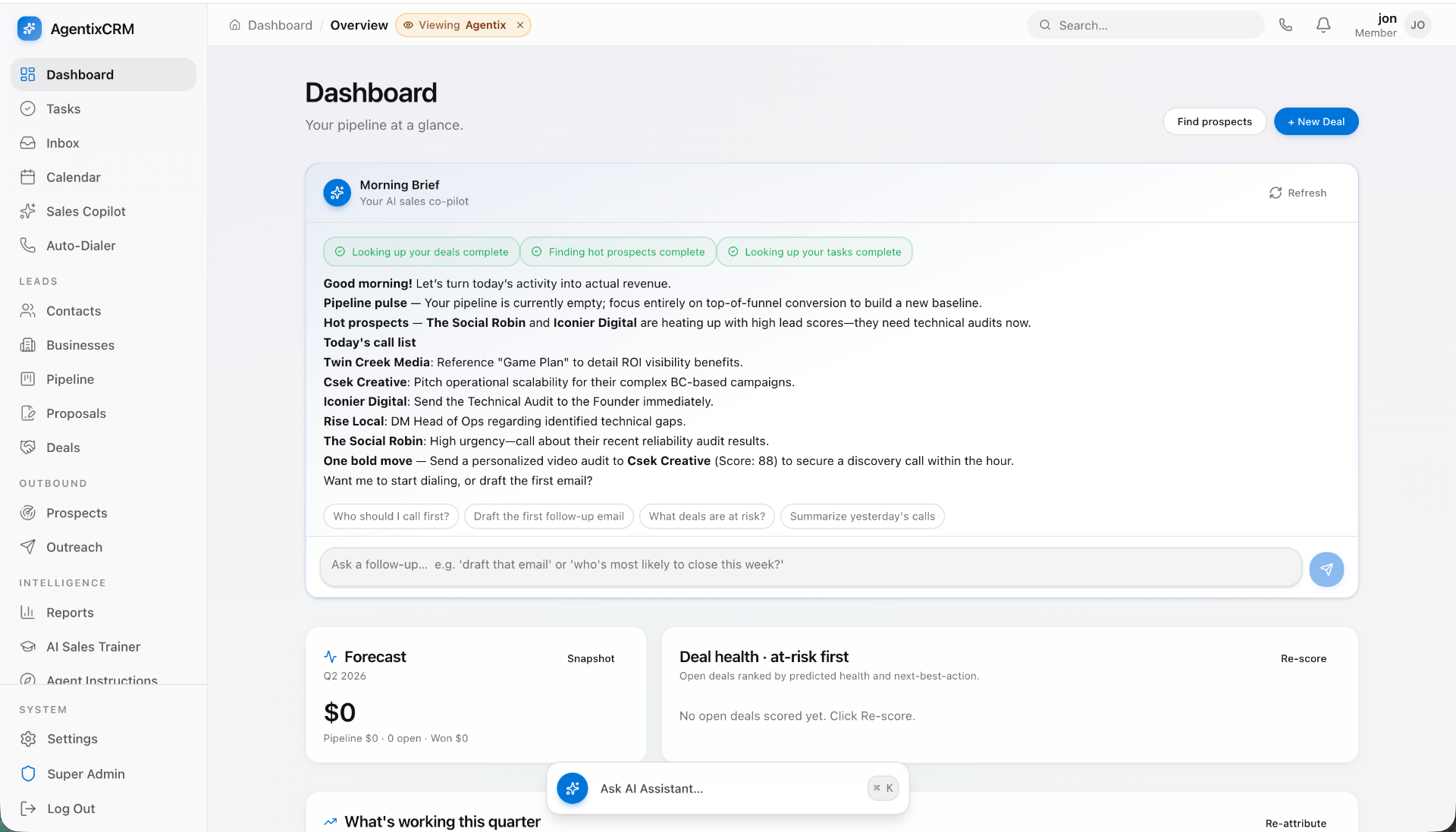
AgentixCRM
Your AI sales co-pilot — pipeline, prospecting, and the next-best call, all in one CRM.
View case study
Pros Nearby
Stop chasing quotes. Get matched with vetted local home-service pros in minutes.
View case study
Loan.me
When lenders compete, you win — compare real loan offers from 300+ partners in minutes.
View case studyReady to ship CRM Data Entry for your storage facilities business?
Book an AI Workflow AuditMost storage facilities go live with their crm data entry agent in 4–6 weeks.